
How RUCKUS Wi-Fi Evolved for Massive Outdoor Environments

Dedicated outdoor access points are crucial for coverage in expansive environments exposed to the elements. Outdoor events such as concerts and festivals are just two examples where stable, high bandwidth connectivity for a huge number of concurrent users is no longer a luxury, but an essential requirement to ensure an event runs smoothly. Over the years, the number of concurrent users has risen, and with streaming services now providing HD/4K/8K video as standard, demands on bandwidth have increased quite drastically too.
Likewise, shopping centers, holiday parks, hotels and other hospitality venues such as restaurants and bars, many with expansive outdoor seating and dining areas, have increased expectations for their wireless networks too. Durable, reliable and efficient connectivity for both their own operations and guest satisfaction is essential.
So how did RUCKUS innovate to become market leaders in enterprise grade outdoor wireless?
Some of the first access points RUCKUS released to the market were modest omni-directional Wi-Fi radios – perfect for requirements of the time, but limited in scalabilty for the demands of today. However, RUCKUS constantly innovated and evolved to stay ahead of the pack and transformed their outdoor wireless products into the high-density platforms they are today – capable of handling some of the largest, most demanding environments imaginable. As the key distributor for RUCKUS wireless products from 2008 to the present day, Purdicom witnessed this evolution first hand. This is the story of how RUCKUS kept ahead of the game to become one of the most innovative leaders in outdoor Wi-Fi today.
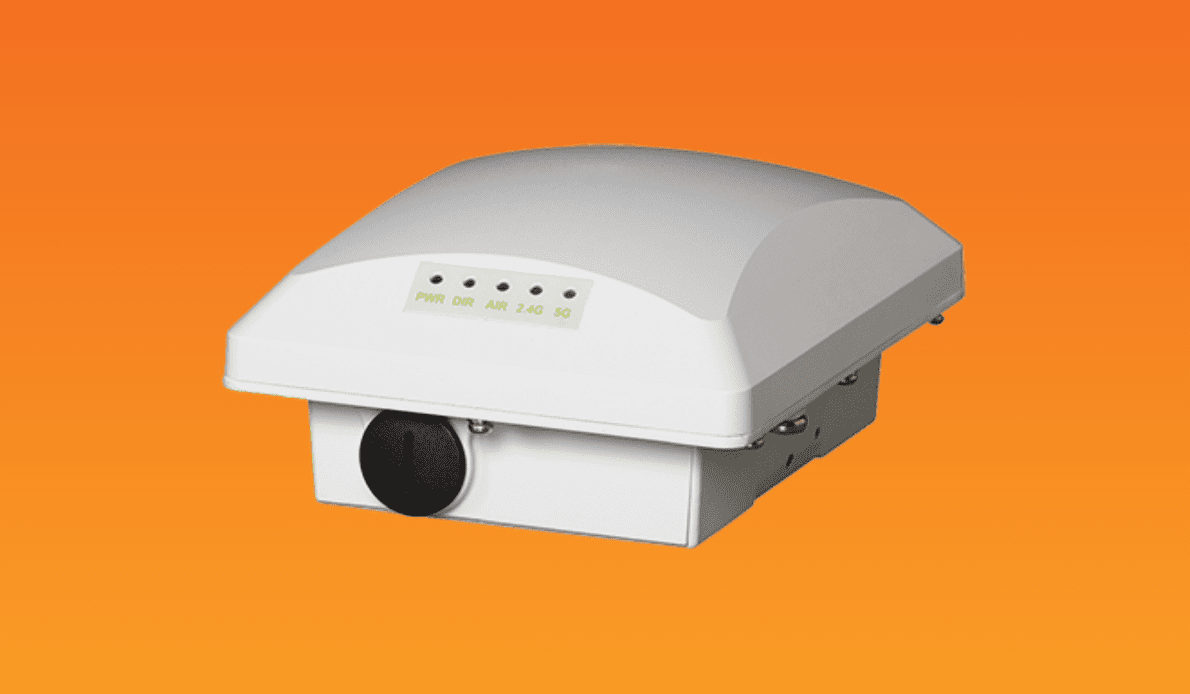
RUCKUS T300 – The Beginning Of An Era
The original T-series outdoor AP was the ZoneFlex T300, an enterprise grade access point with 1Gbps Ethernet uplink built just to provide dependable 802.11ac connectivity whilst in public areas like shopping and conference centres. It was lightweight, weather-resistant and a stable product designed to be located outside and capable of handling tough conditions.
The T300 was built to tackle outdoor locations which the classic omni-directional APs have struggled with and despite the evolution of the access points since the T300 release, BeamFlex adaptive antenna technology was used with this device, helping with adjusting antenna patterns per-packet to maximise performance and reliability in dense user environments.
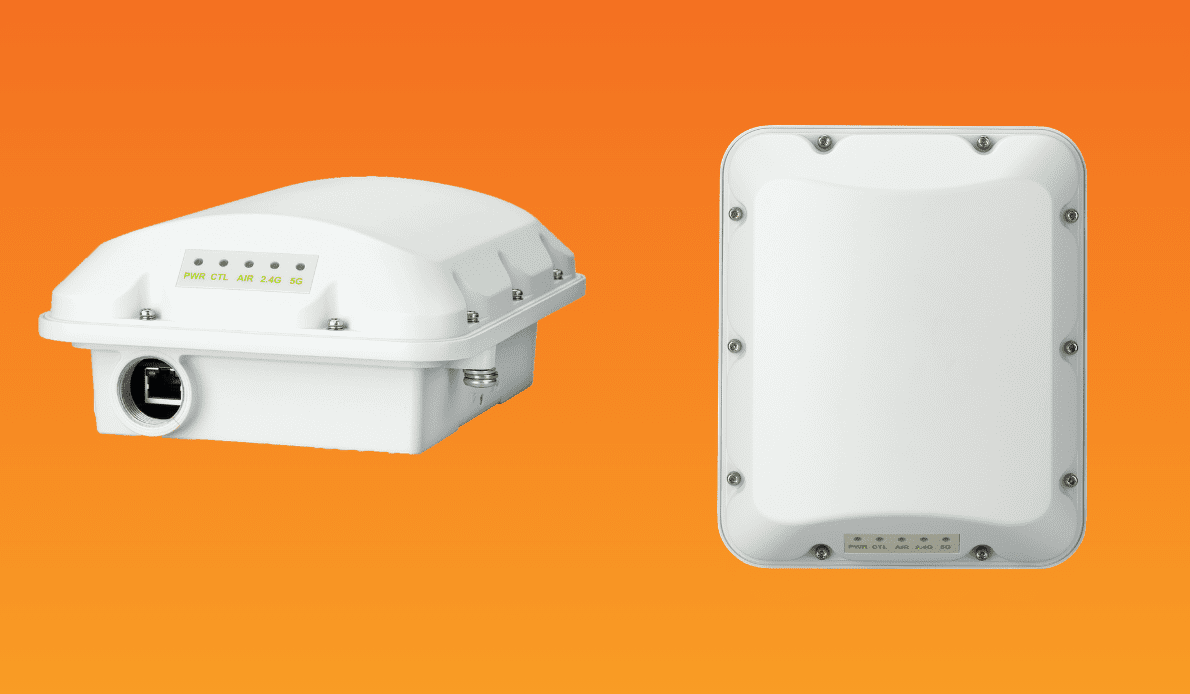
RUCKUS T350 – The Increase in Density and Demand
The direct replacement for the T300 is the RUCKUS T350 – a marked upgrade on its predecessor. Currently still active and available for shipping thr T350 delivers Wi‑Fi 6 performance with 2×2:2 MU‑MIMO, providing reliable coverage for smaller public spaces such as parks and campuses. As device density and Wi-Fi demand has continued to rise, the expectation to deliver strong and reliable coverage has risen too, that’s why it instantly became a favourite for parks, campuses and public squares.
Despite its obvious improvements over the T300, it was never designed for extreme high-density environments and can struggle to maintain the same level of performance when confronted with them. Its 2X2:2 Wi-Fi 6 radio has far fewer spatial streams and less capacity than newer WiFi 7 APs, and its 1Gbps uplink makes for limited scalability in some circumstances – it wasn’t engineered to handle locations such as stadiums and festivals. However, because of its obvious performance increase on the previous model, it was well suited for the new era when it was released – it also contained several new features that made it suitable for a wide range of deployment scenarios of the time.
While the older T300 was based on the orignal BeamFlex technology, the T350 features BeamFlex+, an enhanced version with extended capabilities making for clear technological progress. Its IP‑67 enclosure, integrated BLE/Zigbee IoT radios, and flexible PoE powering not only made it durable but positioned it as a bridge between traditional outdoor Wi‑Fi and modern sensor‑rich IoT deployments. While it might not reach the horsepower available with the latest WiFi 7 APs, the T350 is still a cost effective, straightforward outdoor access point easily capable of moderate density.
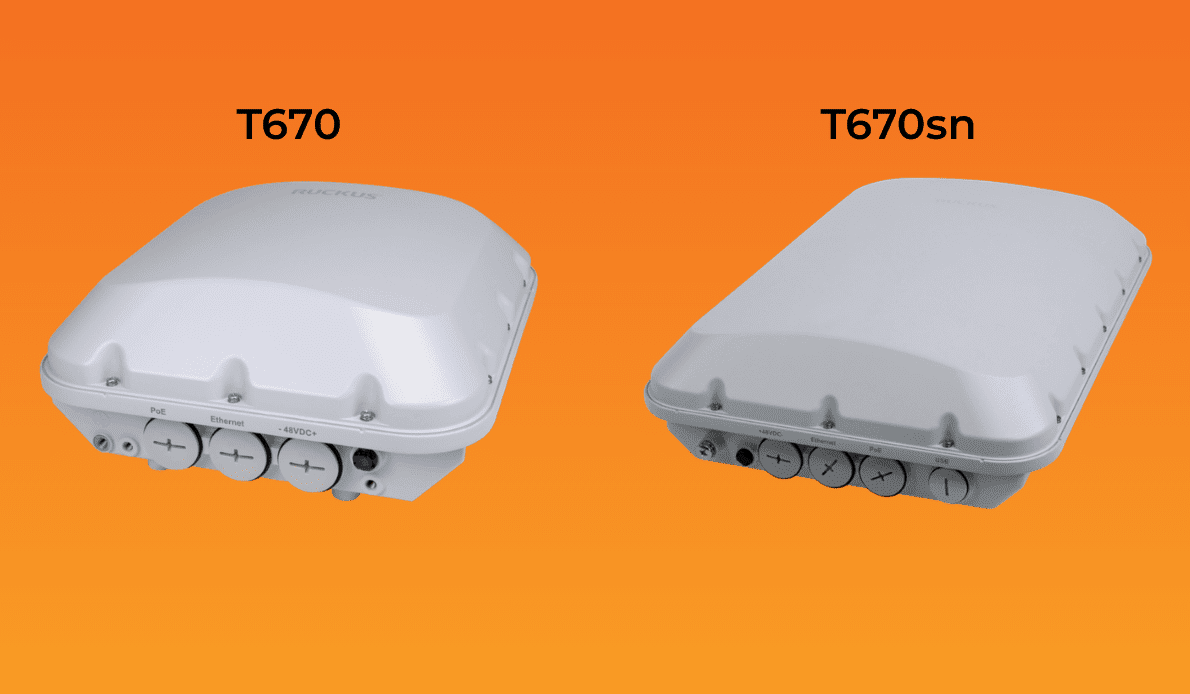
RUCKUS T670 and T670sn – The Biggest and Best
Since the T350, RUCKUS has released two newer outdoor access points – the T670 and T670sn. These are the winning solutions to performance-levels dropping in very high-density environments. Both are equipped with Wi-Fi 7 and are the first outdoor APs in the range to be immediately capable of running at the fastest speeds available with up to 9.34Gbps throughput.
However, it isn’t just the speed that makes Wi-Fi 7 superior to its predecessor, a key feature called MLO (Multi-Link Operation) is also included within these APs. Where earlier access points used to operate over one band – 2.4, 5 or 6GHz – with MLO data can now pass across multiple bands simultaneously or switch to the cleanest available band. Having MLO alongside BeamFlex+ adaptive antenna technology means these newer WiFi 7 APs are ideal for a much wider range of very high-density environments – such as stadiums, smart cities, transportation hubs and special streaming use cases.
Another feature making the T670 models superior to the T350 is the 5Gbps Ethernet uplink, which helps eliminate wired links back to the network due to AP bottlenecks. Previous APs – including the T300 – were limited to 1Gbps uplink making it harder to handle increasing network demands.
One of the biggest issues when operating in very densely populated areas are the bottlenecks caused by large numbers of users trying to access the network at the same time. Thanks to the fast uplink and overall performance of the latest Wi-Fi 7 APs, this is no longer a problem – and to accompany the uplink speed, RUCKUS AI is utilised for real time optimisation to ensure the latest models maintain stable connectivity that scales easily, even in the most demanding environments.
From Reliable Outdoor Coverage to High-Density Performance
The evolution of RUCKUS outdoor Wi-Fi technology reflects the dramatic shift in how we connect in public spaces. From the modest T300 which started this evolution, first bringing reliable outdoor connectivity to parks and urban environments, through the T350’s introduction of IoT integration and BeamFlex+ enhancements, to today’s powerhouse T670 series with Wi-Fi 7 capabilities – each generation has strived for higher performance in increasingly demanding environments and delivered.
What sets the latest T670 and T670sn apart isn’t just raw speed, though their throughput is impressive. It’s the connected approach to solving real-world challenges: Multi-Link Operation ensuring seamless connectivity, 5Gbps uplinks eliminating bottlenecks, and RUCKUS AI optimising performance in real-time. These aren’t minor adjustments – they’re game-changing solutions designed for stadiums packed with tens of thousands of streaming fans, smart cities managing countless IoT sensors, and transportation hubs serving exceptionally large numbers of concurrent users.
As user expectations continue to climb and new applications emerge, from 8K streaming to VR experiences, RUCKUS has proven its commitment to staying ahead of the curve. The T-series journey so far has demonstrated that outdoor Wi-Fi is no longer just about coverage – it’s about delivering the best, high-density performance in the harshest conditions imaginable.